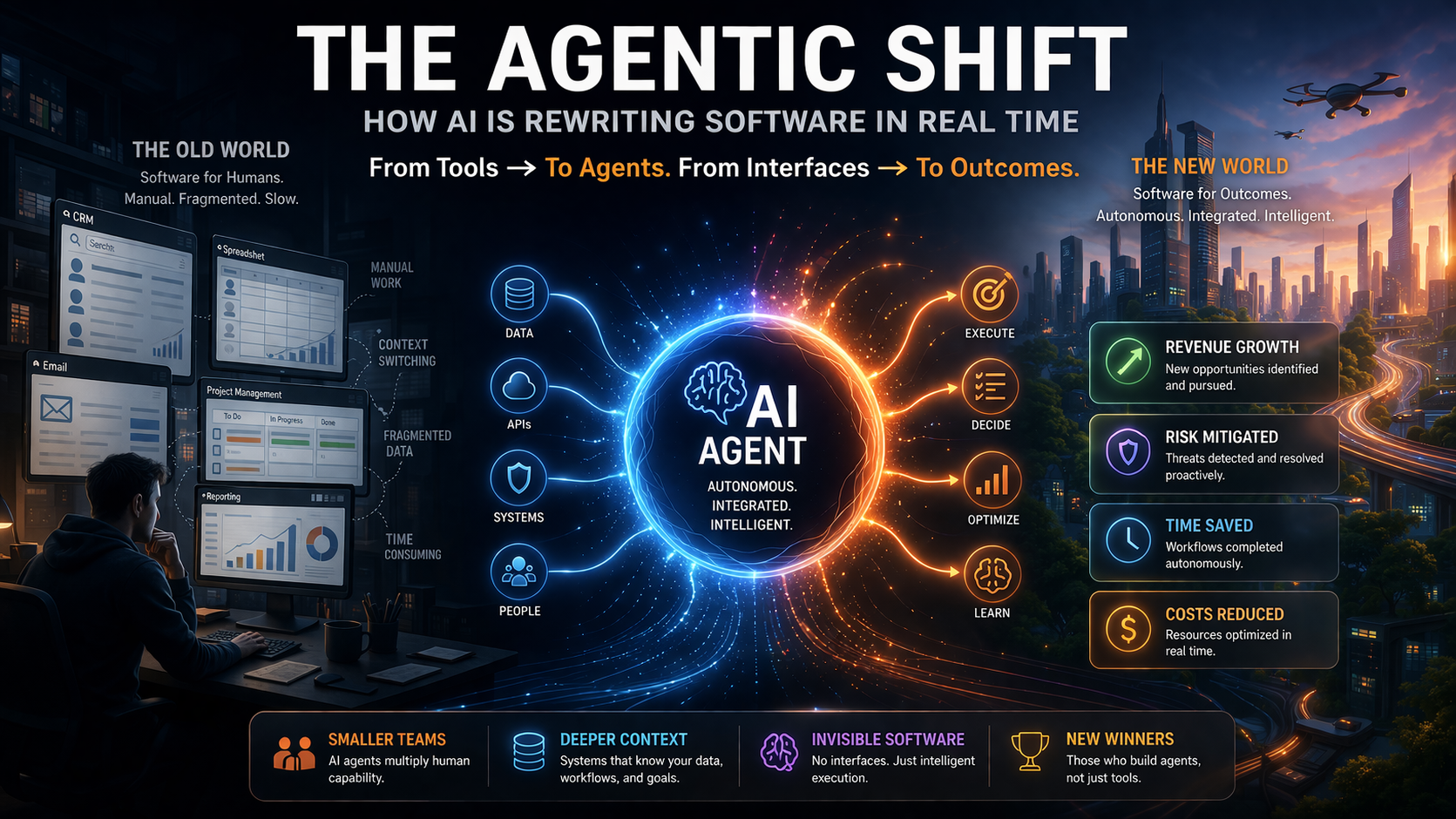
The Inflection Point Has Arrived
Today marks a clear turning point in the software industry.
For years, AI has been layered on top of existing tools writing code, summarizing documents, assisting users. But what we’re seeing now is fundamentally different:
👉 AI is no longer assisting software. 👉 AI is becoming the operator of software.
This transition from assistive to agentic systems is redefining the role of applications entirely.
From Interfaces to Outcomes
The traditional software stack was built around human interaction:
Dashboards Buttons Forms Workflows
But AI agents don’t need interfaces. They need access and intent.
Instead of navigating a CRM, an AI agent can:
Identify a sales opportunity Enrich the lead Draft outreach Execute follow ups Update records
All without human input.
This signals the collapse of UI-first design and the rise of outcome first systems.
The Death of “Seat Based” Software
One of the earliest signs of disruption is economic.
For decades, SaaS pricing scaled with headcount:
More employees → More licenses → More revenue
But AI breaks this relationship.
A single operator, augmented by AI agents, can now produce the output of entire teams. That means:
Fewer seats Higher output Pressure on per user pricing
We’re entering a world where pricing aligns with:
Tasks completed Outcomes delivered Compute consumed
In short: software is becoming metered execution
The Rise of Autonomous Workflows
What used to require multiple tools and human coordination can now be handled by a single AI system orchestrating across services.
This introduces a new abstraction layer:
🧩 AI as the Orchestrator
Instead of:
Tool A → Human → Tool B → Human → Tool C
We now have:
AI Agent → Tools (invisible) → Outcome
This reduces friction dramatically, and commoditizes the tools underneath.
The New Competitive Moat: Context
As workflows become automated, the differentiator is no longer feature sets, it’s context.
The most valuable systems will be those that understand:
Your company’s internal data Your workflows and history Your preferences and goals
This creates a shift toward:
Proprietary data ecosystems Deep integrations Persistent AI memory layers
In this world, the “best software” is the one that knows you best.
Workforce Impact: Smaller Teams, Larger Output
AI agents are already compressing team sizes while expanding output capacity.
We’re seeing the emergence of:
1 person or zero product team presence Highly leveraged engineers Autonomous operations roles
This doesn’t eliminate jobs overnight, but it does redefine them.
The new high value roles are:
AI orchestrators System designers Workflow architects
Execution is increasingly handled by machines.
The Invisible Software Era
Perhaps the most profound shift is this:
👉 Software is disappearing.
Not in capability, but in visibility.
Users no longer:
Log into multiple tools Manually move data Execute repetitive workflows
Instead, they define goals, and AI handles the rest.
Software becomes:
Headless Embedded Autonomous What This Means for Builders
If you're building software today, the rules have changed.
Old Playbook: Build features Design UI Sell seats New Playbook: Define outcomes Enable agents Own context
The question is no longer:
“What can users do with this product?”
It’s now:
“What can this system do on behalf of the user?”
Final Take: The Software Layer Is Being Abstracted Away
We are witnessing the early stages of a massive shift:
From software as a tool → software as an autonomous system
The companies that win won’t just add AI features.
They will rebuild around a new core assumption:
👉 The primary user is no longer human.
And once that assumption changes, everything else follows.
HeadChief Insight: The next billion dollar platforms won’t look like apps. They’ll look like agents with access, memory, and authority.