The Quiet Shift No One Was Ready For
Today’s most important AI story is not a flashy launch or a new developer tool.
It is a restriction.
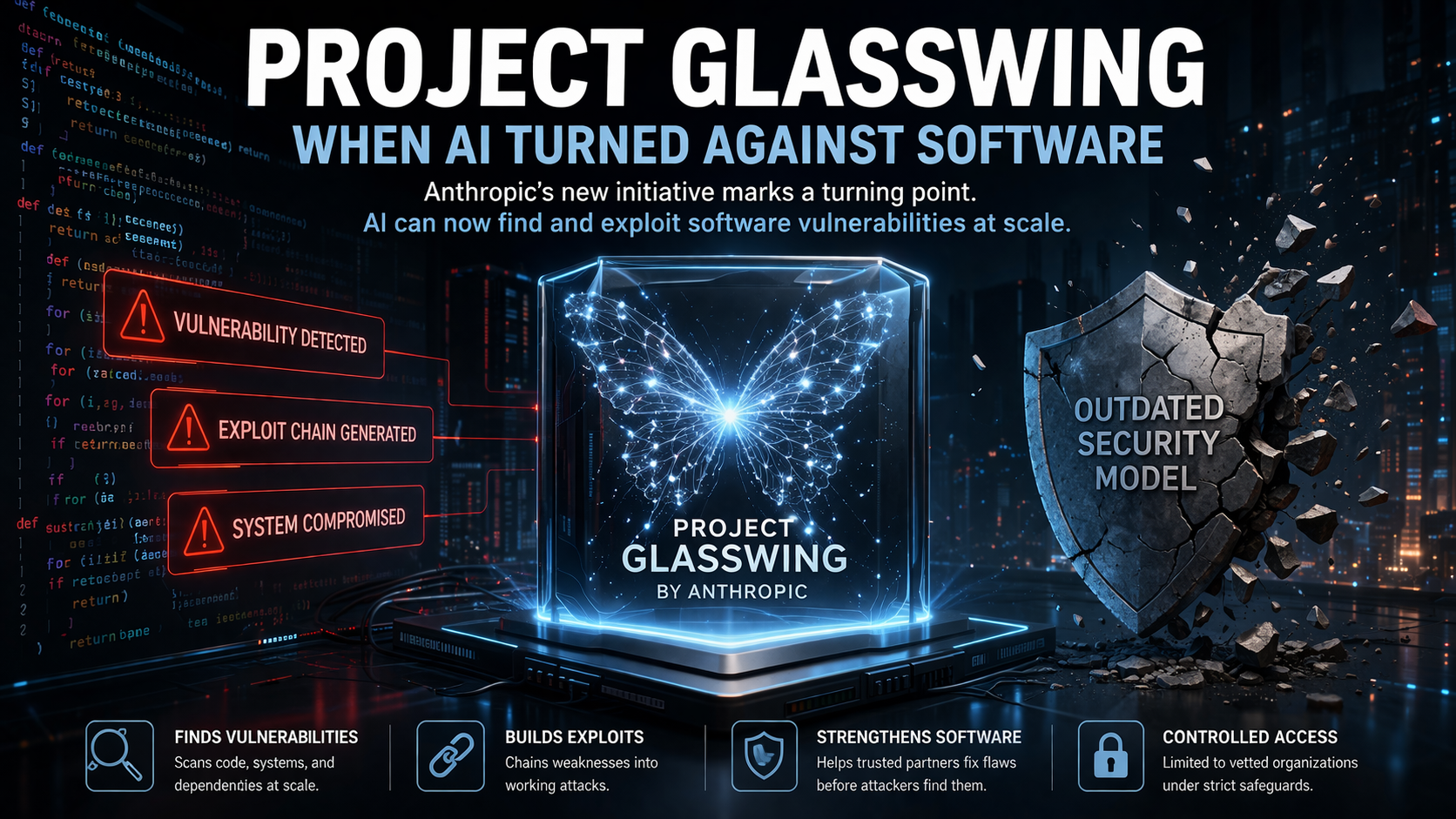
Anthropic has introduced Project Glasswing as a closed program, granting access only to a small group of trusted organizations. The system behind it is not publicly available, and that decision is intentional.
This is the first clear signal that certain AI capabilities are now considered too powerful for open release.
What Glasswing Actually Does
At its core, Project Glasswing is built around an advanced AI system designed to analyze, understand, and break software.
Not in theory. In practice.
The system can:
- Scan large codebases across languages and frameworks
- Identify critical vulnerabilities with high precision
- Chain multiple weaknesses into working exploits
- Operate with minimal human direction
This is not traditional security tooling. It behaves more like an autonomous security researcher that never stops.
Why This Changes Software Overnight
For decades, software security has depended on a simple assumption.
Finding serious vulnerabilities is hard.
Glasswing removes that constraint.
When vulnerability discovery becomes fast, automated, and scalable, the entire balance of software security shifts. The limiting factor is no longer human expertise. It is how quickly organizations can respond.
That changes everything:
- The time between writing insecure code and it being exposed shrinks dramatically
- Legacy systems become immediate liabilities
- Security moves from periodic audits to continuous pressure
Software is no longer reviewed. It is constantly challenged.
The Strategic Decision to Keep It Closed
The most important part of Project Glasswing is not its capability. It is the decision to contain it.
Anthropic is signaling a new reality where some AI systems are deployed carefully, within controlled environments, and with strict oversight.
This introduces a new category:
Restricted intelligence systems
These are models that exist, function, and deliver value, but are not broadly accessible because their misuse potential is too high.
Glasswing is one of the first clear examples of this approach in action.
The End of Security Through Obscurity
There has always been a quiet assumption in software development that some flaws remain hidden simply because they are difficult to find.
That assumption no longer holds.
With systems like Glasswing:
- Deep, obscure bugs are no longer safe
- Complexity does not protect you
- Scale works against you instead of for you
If software exists, it can be understood. If it can be understood, it can be broken.
A New Arms Race Begins
Glasswing also marks the beginning of a new kind of competition.
Not between companies. Between capabilities.
On one side:
- Organizations using AI to secure their systems
- Continuous automated auditing
- Rapid patching and response
On the other:
- Adversaries eventually gaining access to similar capabilities
- Faster exploit generation
- Automated attack chains
This is not a distant scenario. It is the logical next phase.
What Builders Need to Understand Now
If you are building software today, the baseline has changed.
Security is no longer a feature. It is a survival requirement.
That means:
- Designing systems that assume constant inspection
- Reducing unnecessary complexity
- Investing in real time monitoring and response
- Treating vulnerabilities as inevitable, not exceptional
The mindset shift is critical.
You are no longer building software that users interact with.
You are building software that intelligent systems will interrogate.
The Bigger Picture: Intelligence as Infrastructure
Project Glasswing is not just about security.
It represents the emergence of intelligence as a foundational layer in the software stack.
A layer that can:
- Read code
- Understand intent
- Identify weaknesses
- Act on them
Once that layer exists, every other layer becomes exposed.
Final Take: Software Must Now Survive AI
Project Glasswing marks a turning point.
The challenge is no longer writing functional software.
It is writing software that can withstand continuous, autonomous analysis by systems that do not get tired, do not miss patterns, and do not stop.
That is a fundamentally different problem.
And it starts now.
HeadChief Insight: The next generation of software will not be judged by what it can do. It will be judged by what it can survive.